

Endurance Events and Lactate Testing
With Emphasis on the Triathlon
13 of 19
How to use lactate testing
to set and monitor training paces
Other Important Uses of Lactate Testing
Lactate tests are used to set training paces. The test gives the V4 for each discipline. What the coach or athlete then does with these pieces of information is the real key to success. For the recreational athlete there are easy ways to calculate regeneration and extensive training levels for swim, bike and run, and what some intensive effort levels are. Any training program can make use of these levels or establish other levels in order to plan training.
For example, here is a simple way to estimate regenerative or extensive paces from a V4 pace. If the athlete is a recreational triathlete, estimate that regenerative or extensive paces are about 85%-90% of the V4 pace. For example, if the V4 is 3.30 m/s or about 5:03 per 1000 m then the regenerative paces would be about 3.0 m/s or about 90% of the V4 pace.
For an elite triathlete whose V4 pace was 5.49 m/s the regenerative pace would be about 3.9 m/s or 70% of the V4 pace. To the normal observer, this sounds odd. The low level triathlete can do most of his volume at 90% of the V4 pace while the elite triathlete who competes with the world's best must do his regenerative workouts at 70%-72% of his V4. But if one realizes that the V4 of the elite triathlete is probably about 92% of VO2 max while the V4 of the recreational triathlete is only about 75% of VO2 max then the recommendations make sense. Both of the athletes would do regenerative workouts at about 67-68% of VO2 max.
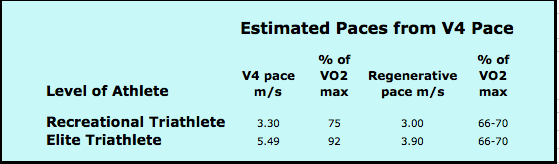
Notice that the regenerative pace of the elite triathlete is about 20% faster than the V4 pace of the recreational triathlete. In other words if the recreational triathlete ran as fast as possible, he would not be able to keep up with the elite triathlete doing an easy run. Most triathletes are between these two examples and as serious triathletes get closer and closer to the elite status, they have to worry a lot more about how fast their paces are during training.
MLSS
If a coach feels it necessary to calculate a MLSS or lactate threshold, then the Secrets of Lactate CD has several testing protocols which allow him or her to use a lactate analyzer to do this.

In the near future, there will be a thorough discussion of thresholds by Sports Resource Group. Two recent good articles have discussed this in detail.
Faude, O., W. Kindermann, et al. (2009). "Lactate threshold concepts: how valid are they?" Sports Medicine 39(6): 469-90.
Binder, R. K., M. Wonisch, et al. (2008). "Methodological approach to the first and second lactate threshold in incremental cardiopulmonary exercise testing." European Journal of Cardiovascular Prevention & Rehabilitation 15(6): 726-34.
Comparing Athletes
The following chart which we have presented before quickly indicates where a particular athlete would be compared to the general population of athletes. It is a chart of several different types and levels of runners. An elite triathlete, one expected to do well at Kona Ironman World Championship, would be on the far right of the curve. The running ability of an elite Ironman triathlete is similar to that of a 2:20 marathoner. No Ironman competitor has ever ran such a fast pace in an Ironman race but if the only race of the day was a marathon, then we would expect the top Ironmen to finish around 2:20 or a little faster. The fastest marathon ran in an Ironman race was about 2:36.
.
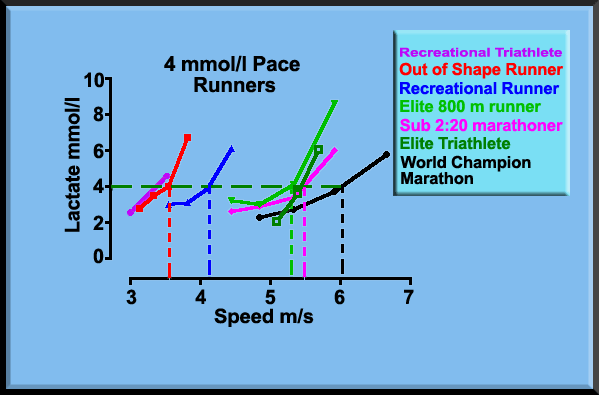
If the athlete is anywhere near world class, then his or her V4 is very near VO2 max and regenerative paces will as a percentage of the V4 be much lower than an athlete who is only moderately talented. So it is not useful to use the same percentage for each athlete. The more successful the athlete the more careful the coach has to be with the overall intensity of the training volume.
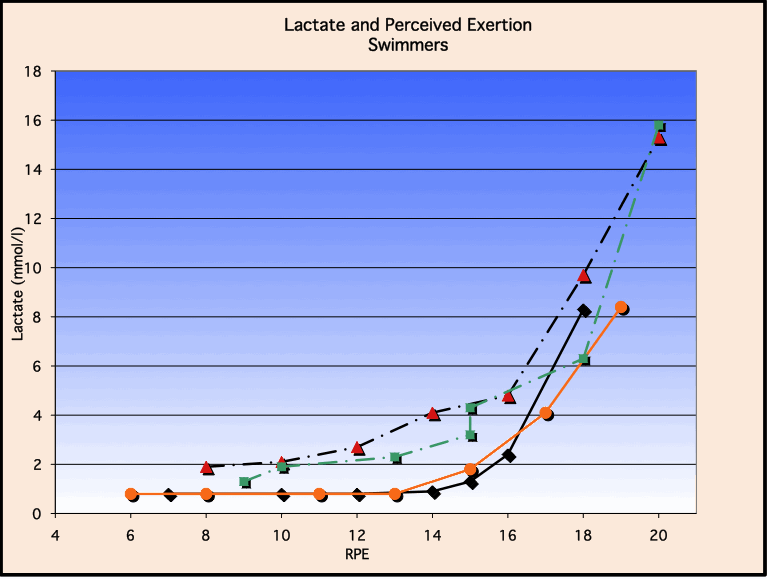
And sometimes perceived exertion or the reaction of the athlete to the set can be very misleading. Two different athletes may have very different perceived reactions to training set at various percentages of VO2 max. Here is a chart of swimmers with similar perceived exertions (rpe) and often very different lactates. So one swimmer telling the coach how a set felt is reporting on an entirely different metabolic experience than another swimmer with a similar description. One may be generating almost no lactate while another may be generating quite a bit. So one is engaging the anaerobic system at a much higher level than the other.
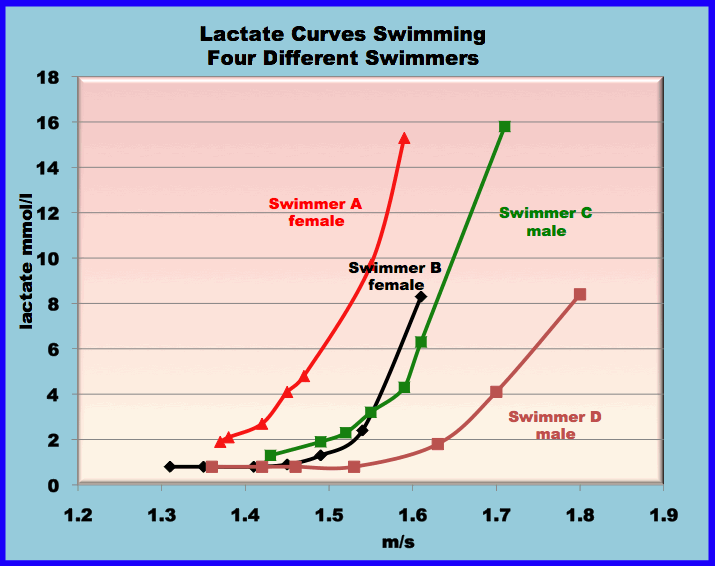
Below are these same swimmers plotted differently. The X axis is speed and it easy to see that their V4s are quite different. The training paces for each will obviously be different but not necessarily proportional. Swimmer D's V4 is 8% greater than Swimmer C's V4 but may only train at 4-5% faster swimming paces than Swimmer A. The reason is that Swimmer C produces a lot of lactate and the V4 probably underestimates his aerobic capacity.
Swimmer D was one of the best swimmers in the world and his V4 represents the upper end of what one can expect to see with any swimmer. Also these tests were based on a 7 x 200 m protocol commonly used in analyzing swimmers. A test using 400 m swims would cause the V4 to drop off about 2% but it would be difficult to require as many as 7 stages of 400 m. Swimmer B was also one of the better women swimmers in the world and can be used as a benchmark to judge other swimmers.
Control Tests
It is essential that the coach or athlete verify that the athlete's workouts are at the level planned. That is why a control test is so important at various times during the training cycle. It is essential within a week or two after a standard lactate test to verify that the test was telling the coach the right things. For example, the swimmer mentioned previously was to swim most of his workouts at 1:15 to 1:17 and occasional sets just below the V4 pace at a higher intensity than these regenerative paces. So the coach had the athlete do a set of 10 x 100 m with 30 seconds rest a couple of seconds slower than the V4 pace. The results are below.
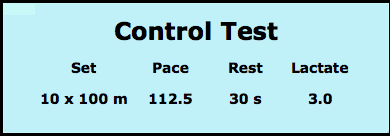
This set acted as part of the athlete's workout for the day and confirmed that the estimated paces for regeneration and extensive workouts were correct. Control tests are an excellent way to verify that an athlete is at the right intensity during a workout. It is also an excellent way to alert a coach and athlete that something is wrong. Suppose this exact same test was done three weeks later and the results were as follows:
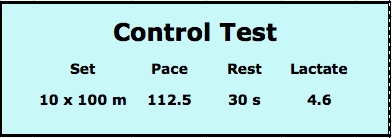
The coach would know that something was wrong with the training paces and try to head off a major problem before the situation got worse.
Continue on to Module 14 on a closer look at anaerobic energy processes and the Secrets of Lactate
Module 14 of 19- a closer look at anaerobic energy processes and the Secrets of Lactate