lactate dot com logo
 
lactate experts


Lactate Testing for Triathlon


A Short Introduction


A simple lactate test protocol provides many important indications for appropriate training. However, the ultimate goal, optimal performance, requires more lactate tests, appropriately timed. A regular evaluation of actual training (stimulus) and the lactate test results (reflecting training response) provide the real benefit of lactate testing and allows the coach or athlete over time to determine each athlete’s “best training practices”.

(The ideas in this discussion are based on Jan Olbrecht’s years of experience working with elite athletes.  Dr. Olbrecht was the training adviser for Luc van Lierde, two-time Ironman World champion, holder of the record for the fastest Ironman at Kona and the fastest Ironman ever completed.  Dr. Olbrecht also provided training advice to several other world champions and Olympic medalists in swimming and rowing in addition to his work with triathletes.  He is the author of one of the best books on training, “The Science of Winning.” )


This section is a short introduction on the rationale for lactate testing and specifically lactate testing for the triathlon. In order to quickly introduce some of the reasons why lactate testing is important and why the material discussed in this document will change the way you look at training not only for the triathlon but for any sport, a few short obvious points will be presented.

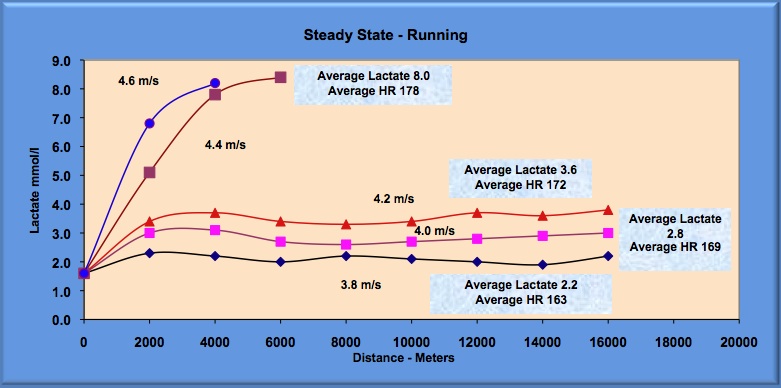
First, there exists a maximum effort in any racing discipline (swimming, cycling, running, rowing, canoeing, kayaking, skiing, speed skating etc.) that an athlete can continue for an extended period of time without having to slow down, usually an hour but sometimes longer. This pace once was called the maximum steady state speed. But sports scientists noticed that as long as the athlete maintains this effort level his or her lactate level remains constant. At small increases in the effort level above this pace, the athlete’s lactate level will rise slowly and he or she will be forced to stop, sometimes within a few minutes or sometimes after an extended period of 20-30 minutes. Above this maximal lactate steady state there are no more steady states but an inevitable and frequently rapid progression to exhaustion. The name of this pace was changed to Maximum Lactate Steady State pace (MLSS or MAXLASS) to reflect this phenomenon. Other names have been associated with this pace such as the anaerobic threshold, the lactate threshold and the onset of blood lactate accumulation (OBLA). However, these three terms have slightly different meanings depending upon who is using them and what is being discussed. We use the terms interchangeably with MLSS in our document but recognize that they have a variety of origins and other uses..

The relevance of lactate in the preceding phenomena has been highly debated over the years. Many have claimed that lactate itself is not a source of fatigue. We agree with that. However, no one has disputed the relationship between lactate and the maximum lactate steady state or claimed that MLSS does not exist. What causes an athlete to stop when he exercises for an extended time above the MLSS is not entirely known. But whatever it is correlates nearly perfectly with the accumulation of lactate in the muscle.

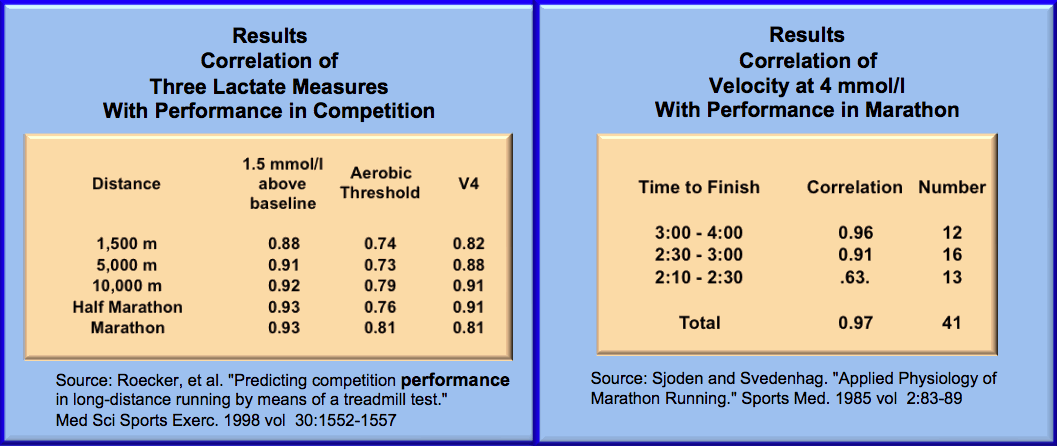
Second - the maximal lactate steady state or the lactate threshold is the single best indicator of endurance performance. Generally the athlete whose MLSS is at the higher effort level (speed or power) will be faster in an endurance event. Increases in the pace at which the MLSS takes place are almost always accompanied by improvements in race performance for endurance events. So periodic lactate testing (every 4-6 weeks) is usually the best indicator of potential race performance for endurance events. It is also generally the best indicator of training improvement or training ineffectiveness. For short events such as most swimming, track cycling, speed skating and rowing races, the maximal lactate steady state is also highly correlated with performance. But anaerobic capacity (the ability to produce lactate and speed) becomes more important in shorter events and this has to be understood as an athlete in these sports progresses through a training season. This topic is covered in detail on our Secrets of Lactate CD-ROM. Lactate testing is the simplest, most direct way to make an evaluation of the response of the body to training and certain lactate measures correlate very highly with performance.
An Insight into Athletic Performance

What does the term faster mean? This is not a silly question, and the answer to it is the secret to an optimal physiological performance in a race. It usually means who can get to the finish line faster. That depends on whether the finish line is 200 m away, 1,500 m away, 10,000 m away, 26.2 miles away for a runner or 140.6 miles for an Ironman length race? Who may be faster over 200 m will almost certainly not be the fastest over 1,500 m and may not be able to finish a race of 10,000 m, let alone a marathon. And many triathletes may not be able to finish an Ironman. The following discussion will illustrate what is obvious to everyone but which is rarely considered when preparing for a competition.

The primary physiological objective of training is to maximize the rate of energy release for the event that the athlete is preparing. We emphasize rate because it is the ability to sustain a high rate of energy production per unit of time over the entire event that is important, not the maximum capacity for producing a short burst of energy.

Let’s look at two very different runners, a sprinter and a marathoner. First, have them race each other at 200 m. The sprinter will beat the marathoner over 200 m fairly easily because the sprinter is able to sustain a higher rate of energy production for 200 m. The typical person would say the sprinter is faster.

For a longer race the situation is reversed. The marathoner will beat the sprinter over 10,000 m because the marathoner is able to sustain a higher rate of energy production for 10,000 m. The time we estimated for the sprinter over this long distance is optimistic since it is unlikely he will be able to even finish the race.

The typical person would say the marathoner is not necessarily faster but has better endurance.
In fact the marathoner is faster over the 10,000 m course. But why?

What is it about the metabolism of the marathoner that enables this higher rate of sustained energy production for a 10 k race? A typical response has been that the marathoner has a higher VO2 max. But is this true and if true is this the answer?

In each situation the runner who won the race was able to sustain a higher rate of energy production per unit of time for the length of the race. In each race both runners were using their aerobic and anaerobic systems.

Most would say that the reason marathoners do better in the 10,000 m is because they have a better aerobic system than the sprinters. This may or may not be true. World-class sprinters often have aerobic systems that are as strong as top marathoners. Finalists in the 400 m Olympic finals almost assuredly have extremely high aerobic capacities. So why do marathoners do so much better in longer races? The main reason marathoners can run faster over 10,000 m is not that they have a stronger aerobic system but a weaker anaerobic system.

To say that someone is faster because they are weaker in something seems to be a contradiction. We have been conditioned to think that if one athlete is faster than another then they are somehow stronger. But we will show that this apparent paradox is one of the keys for successful training of most athletes who compete in distance events as well as short events such as swimming.

Now, consider three runners, an elite sprinter, an elite middle distance runner and an elite distance runner. We ask each to run their best in three different races, 200 m, 1500 m, and 10,000 m. We then see who is fastest by measuring the meters per second pace for each race. We also measure the VO2 max for each runner and find that the middle distance and distance runner have almost identical aerobic capacity and that the sprinter is surprisingly fairly high too.

The following chart illustrates how each athlete does at each distance. Two things pop up and each is obvious. Each athlete wins easily at his preferred distance. The speed at each event goes down as the distance for the event increases,

But why should this happen if VO2 max is not much of an issue especially for the middle distance runner and the marathoner. Why can’t the middle distance runner do as well as the marathoner in the 10 k race and why does the marathoner not do as well as the middle distance runner in the 1,500 m race? Why does the middle distance runner beat the marathoner so easily at 200m? It cannot be VO2 max because the athletes are the same on this criterion. The answer to this is what is behind performance at any distance. Namely, it is the interaction of the aerobic and anaerobic systems. It is anaerobic capacity that is driving the speed at which the athlete can complete the race. But in different ways for the 200 m race than the 10,000 m race.

This unconventional explanation for the marathoner’s success at longer distances and the middle distance runner’s success at shorter distances is at the heart of these discussions. The Triathlon training document will hopefully change your conceptions about the physiology behind a peak performance, show why the rate of energy production is key to achieving a peak performance, and help you understand why the rate that lactate is produced and consumed is at the heart of maximizing the rate of energy production during a race. Once this link is made then the usefulness of lactate testing becomes obvious.

One other question about these athletes is, do they have similar lactate responses to running? The answer is no. The middle distance runner and the marathoner will be similar but be very different from the sprinter. The chart below shows what happens to lactate in the blood as each type of athlete runs faster and faster. But notice that at every speed the sprinter generates more lactate in the blood and at higher speeds the middle distance runner will generate more lactate than the marathoner.

Why Lactate

One might say, lactate is interesting but aren’t there other factors that will tell the coach just as much or possibly more. The answer is lactate is different. Lactate is the unique metabolic variable that indicates the capability of the muscles for an athletic performance. We emphasize "unique" in the preceding sentence because no other metabolic parameter provides the same information. We have already indicated that the speed at which lactate starts to accumulate in continually greater amounts correlates with performance in endurance events.

That in itself is more than just useful. It points to how successful one’s training has been. But also lactate has an extremely important role in energy metabolism. Lactate is an output of the anaerobic process and a fuel for the aerobic process, and levels of it in the blood using a well-designed exercise protocol is indicative of the strength of each system. No other single parameter provides this same information.

The ability of the muscles to generate the contraction speed for a peak performance during an athletic event requires that the energy systems providing energy be fine-tuned so they are balanced properly so the athlete can generate the highest amount of energy per unit of time during a race. Proper training is what accomplishes this fine-tuning or optimal balance. Lactate testing lets the coach know if the balance has been obtained, or how each energy system must be trained in order to optimize the balance. This is not easy. Ignoring the anaerobic contribution because it is hard to assess is not going to make it any less important. And it is very important.

Coaching is a profession requiring both art and science. The building blocks for an optimal performance are many and must be constructed in a proper sequence and must recognize that each individual is different. Some of these building blocks are correct technique, positive mental attitude and a proper diet. However, the cornerstone for this building is precise physiological training. That is the main reason an athlete spends so much time in the water, on the bike, on the track or the road, in the weight room or wherever training is best conducted. Ask yourself; do you know if all those miles/hours of training are paying out?

But what is appropriate physiological training? It is not volume alone, or those who put in the most hours/miles would always win. It is not intensity alone, or those who pushed themselves the hardest would always win. It is not this year’s fashionable workout, or everyone would use the magic workout, and no one would be better than any one else! It turns out that each individual has a distinct way of adapting, and any smart training plan must recognize individual differences. This is a fact of life. Each has to find his or her own best way to the proper balance of the energy systems and peak conditioning on the day that counts, race day.

With proper protocols a portable lactate analyzer enables the coach to measure both the aerobic and anaerobic conditioning of each athlete. Information about both is necessary for the coach to optimize the conditioning of each athlete whether they are a 50-meter freestyle swimmer (about 22 seconds plus per race) or an Ironman triathlete (over 8 hours per race for the world's best). With information on each energy system the coach can plan, control and monitor the training of athletes with a precision not available before. Lactate testing provides the important information that enables the coach to individualize the intensity of each athlete's workout and control their training so they reach performance objectives. No over-training and no surprises come race day.

One Last Thing – What about Thresholds

There are a lot of different definitions of thresholds, all with different physiological significance with respect to aerobic and anaerobic energy supply. The only metabolic threshold that can be considered a reliable reference for the long-term performance capacity of an athlete is the maximal lactate steady state. (MLSS) Two athletes may have the same MLSS, but it could be due to very different metabolic contributions. So two athletes with the same MLSS may have to train very differently. Also an athlete very rarely will train at the MLSS. It is one of the most stressful training exercises there is and a formula for over-training if used more than just occasionally.


Questions, Comments and Ordering Information:
1-800-462-2876 (U.S.A. and Canada)
1-914-747-8572 | 1-914 -741-5623 (fax)

Send email to: info@lactate.com

Last update July 21, 2010 All contents © Sports Resource Group, Inc.